
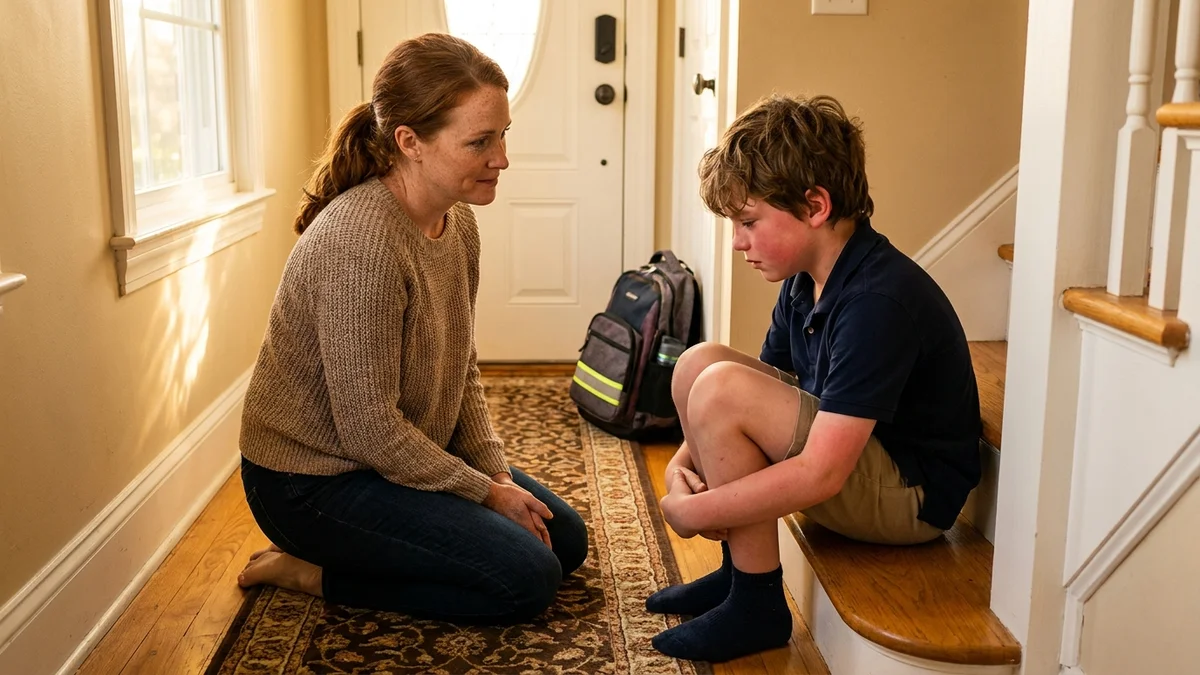
When you think about shame, you probably picture something like a dog being scolded. Head down, slinking away, wanting to disappear. That feeling is one we hand our kids more often than we realize, and almost always without meaning to.
Most of us were raised with shame-based parenting. It came from a generation where doing as you were told was everything. So it makes sense that it’s the tool a lot of us reach for first.
And the uncomfortable thing is that shame works. In the short term it’s quick, and it gets results. That’s exactly why it’s stuck around for so long.
When we shame a child, even in a small way, they don’t hear it as “that choice wasn’t okay.” They hear it as something much bigger and more permanent: “I’m not okay.”
What shame-based parenting actually does
It’s that shift, from a bad choice to a bad self, that does the lasting damage. Over time, “I’m not okay” wears down how a kid sees themselves, and it chips away at the belief that they’re lovable exactly as they are.
Shame also pulls us apart. It tends to show up as the finger wagging, the sharp voice, the wall that goes up between us and our kids. The more we lean on it, the more distance we put between us and our children.
The sneaky little ways it shows up
If I asked you at the school gate whether you shame your kids, you’d probably say no in a heartbeat. And you’d be right that you never do the obvious, finger-wagging kind. It’s the small stuff that slips out when we’re tired.
It sounds like, “Your sister finished all of hers, what’s going on with you?” It feels like nothing in the moment. But to that child, it lands as: I’m the one who’s behind, I’m the one getting it wrong.
You’ll catch yourself doing it, and honestly, so do I. None of us is perfect. Think of it as a spectrum, and just keep aiming for the far end, away from the shame.
What works so much better
The thing that actually undoes shame is connection. It’s meeting our kids with warmth and curiosity instead of a verdict.
It doesn’t mean letting everything slide, or sharing grown-up things they’re not ready for. It just means staying soft with them when they mess up. Instead of the sharp word, you get curious: “Oh bud, what was going on for you there?”
It’s the same thing we all want from a friend after we’ve stuffed something up. Not a lecture, just someone who says, “Oh, I’ve done that a hundred times, don’t be so hard on yourself.” That’s the thing that helps us do better next time.
The next time you feel your finger about to wag, see if you can soften it into a question. And when you forget (which you will because you’re human!), go gently on yourself.